Earth is meant to lose gravity on August 12 for seven seconds according to a conspiracy theory spread online allegedly link to NASA, but what’s really going to happen?
As if there isn’t enough to worry about in the universe already, how about the prospect of losing gravity for seven seconds?
For months, social media posts have been swirling, sharing a that Earth’s gravity will simply ‘stop working’ for just under 10 seconds tomorrow (August 12) as a result of activity to do with black holes.
Professor Brian Cox has shared his thoughts on the conspiracy theory that the Earth is actually flat.
Famous physicist Cox sat down for a interview on recently where he chatted about everything from what he think is ato the possibility of there being life
One question he was posed with was how to explain quantum mechanics to a child (and probably most adults, to be honest).
“Quantum mechanics is the base theory, we think,” Cox said. “I think people tend to think of quantum mechanics as something that applies to atoms, electrons, and particles, but not to us. And that’s not right.”
He further divulged: “Quantum mechanics is the theory that describes everything.When you look at big things, it produces behavior which can be more usefully described by Newton’s laws.”
A former NASA astronaut has lifted the lid on the vital routine that helps space missions run smoothy.
Whether flying to the moon or carrying out experiments on the (ISS), space is no easy feat.
It’s something Crew-11 know all too well; their six-and-a-half month ISS mission was the first in history to be cut short over a ‘serious condition’.
Astronauts Mike Fincke, Zena Cardman, Kimiya Yui and Oleg Platonov today (Thursday January 15) off the coast of San Diego,
NASA confirmed that the early evacuation wasn’t an emergency and all astronauts were doing fine.
Peggy Whitson, 65, worked at for almost 30 years, retiring at the rank of Chief Astronaut in 2018.
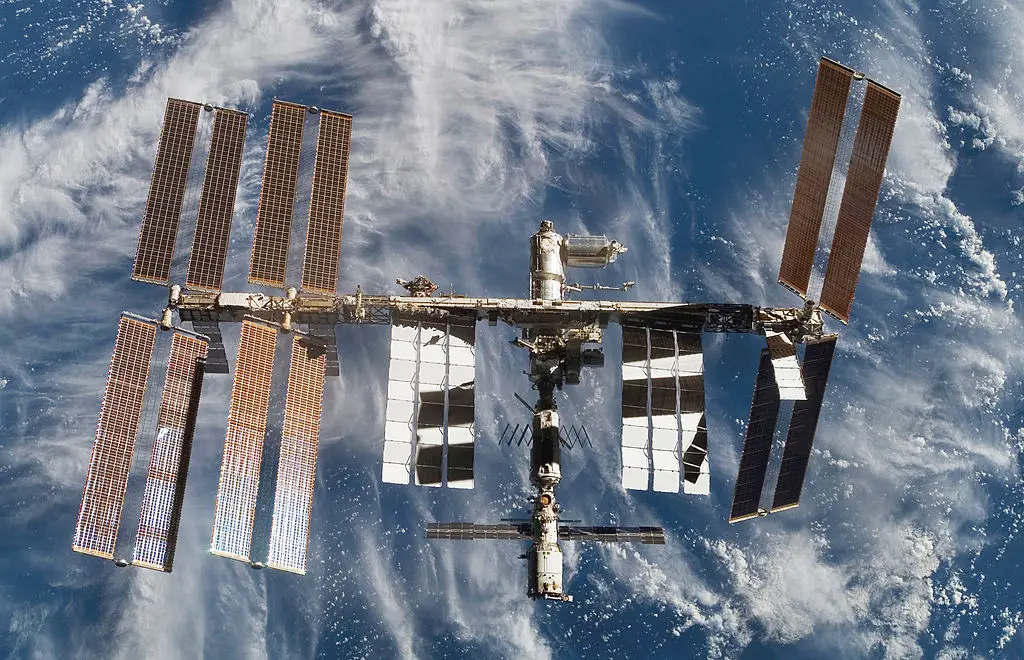
More than 290 people representing 26 countries have visited the International Space Station (ESA/NASA via Getty Images)
She flew multiple long-duration missions aboard the ISS, serving as a flight engineer and later as commander, conducting research in microgravity, supervising station operations and performing spacewalks during extended stays in orbit.
Five years later she joined private company Axiom Space, serving as commander for their 2023 Ax-2 and 2025 Ax-4 missions.
In total, Whitson has racked up an impressive 695 days in space – more than any other woman, or person, for that matter.
Earlier this week, she reflected on her 2025 mission alongside pilot Shubhanshu Shukla of the Space Research Organisation (ISRO) and mission specialists Sławosz Uznański-Wiśniewski, a Space Agency (ESA) project astronaut from Poland, and Tibor Kapu, representing the Hungarian Space Office.
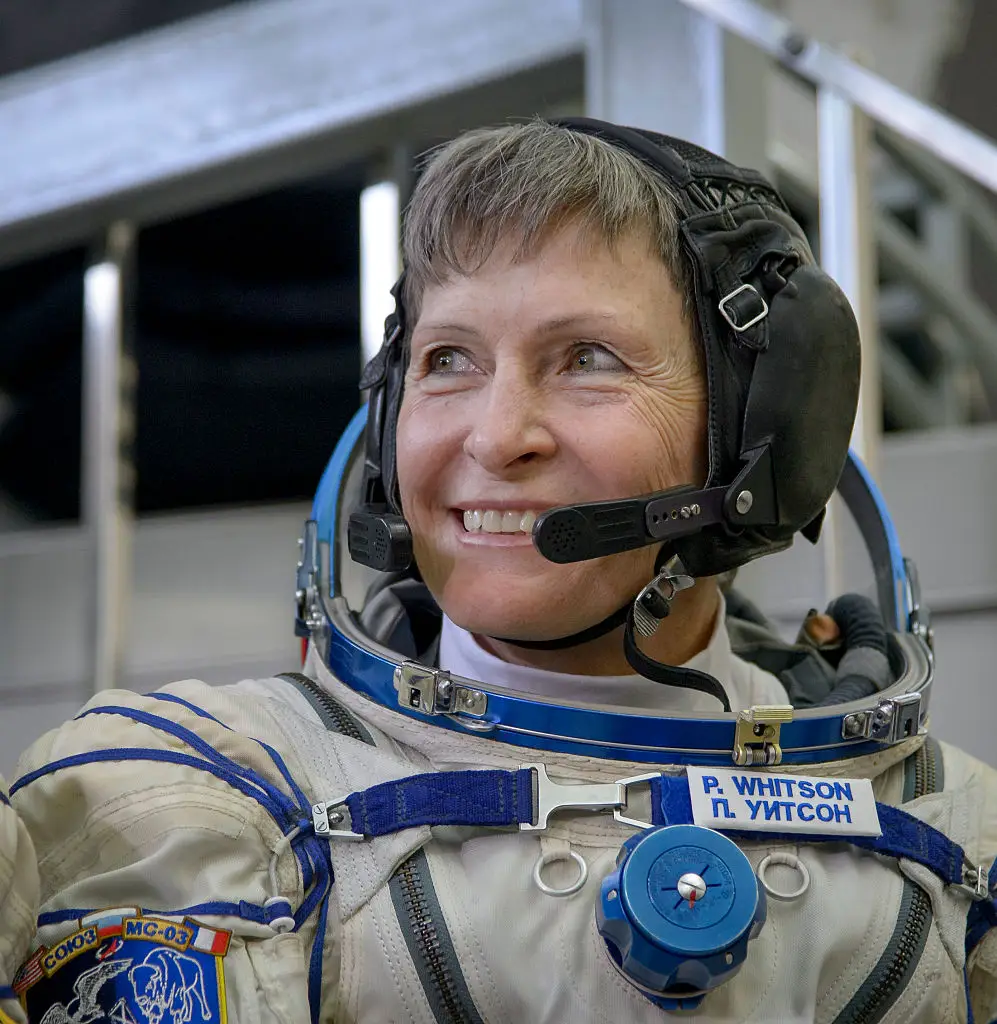
Peggy has spent 695 days in space (Bill Ingalls/NASA via Getty Images)
If you’ve ever been curious as to what an astronaut’s nighttime routine looks like, then let Whitson fill you in.
Explaining that a ‘strict routine while living in space’ is crucial in a successful mission, she highlighted the importance of ‘winding down and sensory shutdown”. “My sleep prep was the same for all my long duration missions while I was with NASA,” she said.
“At supper time, we adjusted the Node 1 lighting to pre-sleep (we referred to it as mood lighting), which has more red wavelengths.
“After dinner, I prepared for sleep an hour earlier than scheduled, because I prefer to work out early in the morning (and have the station to myself).”
Whitson added that the crew quarters have ‘fantastic acoustic dampening,’ so other crew members who were up and about didn’t cause any disruption.
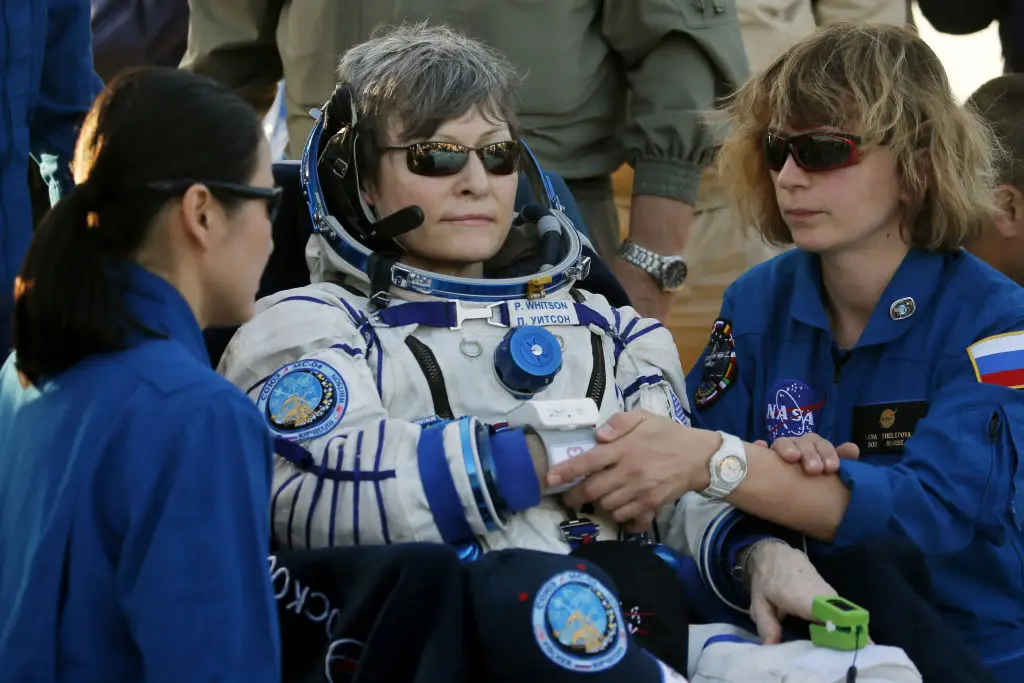
Peggy landing in Kazakhstan after a space mission in 2017 (SERGEI ILNITSKY/AFP via Getty Images)
“Best ever floating on a wall in my sleeping bag, no pillow required!” she added.
“Unfortunately, there are not enough sleep quarters for visiting crew like I was during Axiom missions 2 and 4. Ear plugs became essential for good sleep as I camped out in the Airlock.”
The airlock is a two-chambered pressurized module that serves as the gateway for astronauts to perform spacewalks, acting as a buffer to transition between the station’s living quarters and the vacuum of space.
Whitson isn’t alone in having the best night’s sleep while floating in microgravity.

I have found that having a strict routine while living in space is an important part of a successful mission, especially when it comes to winding down and sensory shutdown. My sleep prep was the same for all my long duration missions while I was with NASA. At supper time,
Previously, Erin Flynn-Evans, a scientist studying spaceflight, explained to Washington Post exactly why that is.
“One of the most common things that the crew members report is that their pain goes away in space, because a lot of the aches and pains that prevent us from sleeping come from gravity,” she said.
“In space, everything sort of eases up, and often that feels good. I can’t think of a time when someone told me they didn’t enjoy sleeping in space, actually.”
Sleepover at the ISS, anyone?

A video of astronauts stumbling around on the moon has prompted people to interrogate whether the landing really was real.
Have humans ever actually stepped foot on the moon? Is the video of walking on it just the result of someone with a dab hand for editing?
Sadly, rather than just celebrating the monumental wins of the world, some can’t help but spread about whether such occasions ever happened at all.
First things first, imagine how many people would’ve had to be kept quiet if landing never actually happened. And not just kept quiet for a few days or weeks, but for over a whopping 50 years. You’d certainly think someone may’ve squeaked by now.
And should you dare raise your concerns about people walking on the moon?
Well, the second person to ever do so has previously who questioned the event. Buzz Aldrin may be 94 years of age now, but it’s best to save the black eye for another day eh?
Unfortunately, after seeing footage of NASA’s moon landing, some people have questioned it’s authenticity anyway, many concerns triggered as a result of how the astronauts appear to – or I should really say try to – walk in the video.
Basically, the video reveals it’s a lot trickier to walk on the moon than people first imagined.

Stay on your feet, lads. (X/Historic Videos/NASA)
The guys up there seem to struggle to hold their balance, as well as finding it tough to get much traction to move around.
In the short video taken up there by the they even seem to get a little frustrated at times. Come on guys, most people can only dream of having the chance to try to walk on the moon – try to have a bit of fun with it.
And after seeing the video shared on a number of people have said that it just makes them more convinced that no-one ever went up there.
One wrote: “It’s so fake that, no other country tried it again,” while another said: “Studio was slippery.”
That’s of course a reference to the theory that the whole thing was shot
To be fair, if it was it’s arguably as impressive as the moon landing itself, given the that would have been available to those in the cinema industry at the time.

Don’t hate until you try (X/Historic Videos/NASA)
Another conspiracy theorist said: “So how is the camera/cameraman so steady……and if they are struggling to walk just one step how did they succeed to set up the camera for the video in the first place????”
Well, the camera would have been on a tripod, therefore nice and steady. Also, they probably dug the legs of the tripod into the dirt.
You see, the problem with trying to walk on the moon is that gravity is so much less up there, meaning that everything only weighs about 17 percent of what it would weigh down on earth.
That’s going to make walking as you would down here difficult.
You’d have to essentially learn to do it all over again in different gravity.

It must just be harder than it looks. (X/Historic Videos/NASA)
What’s more, those space suits can’t exactly have been easy to get around in, can they?
They’re huge – which they have to be – and presumably movement would be reduced.
Add all the other factors to that, and you can start to see why they might have struggled.
Or, perhaps they just filmed it in a sound stage at Area 51 in New Mexico, with an alien standing behind the camera dressed as Stanley Kubrick.
Space travel has produced some mind-boggling photos of our galaxy – there’s no doubt about that.
This photo showing the between the Earth and Moon and an taken by the ‘most isolated’ man in the universe serve as the perfect examples.
And now, photos supposedly from have been doing the rounds. However, as always with the internet, you can’t believe everything you see…
Viral photos show the red planet’s rocky surface in the foreground and a dazzlingly bright night sky in the background, allegedly ‘untouched by Earthly light pollution’.
People were left floored, as one person pondered: “Is that what all humans saw before light pollution…? No wonder they lived so differently and said ‘the heavens above’ all the time…”

The viral images users claim are from Curiosity (TikTok/NASA)
A second agreed: “Everyone on Earth would be a lot more humble if we could see that above us every night,” while a third wrote: “Holy moly! New hobby discovered: Looking at the night sky on Mars!”
There’s no denying the images are breathtaking, but they’re likely made up of two composite photos spliced together.
In fact, themselves made a YouTube video debunking these posts.
Abigail Fraeman, deputy project scientist for NASA’s Curiosity Mars rover, took a similar image and explained: “In the foreground of this altered image, you see Curiosity. In the background, a stunning starfield.”
She explained that the original image from Curiosity was taken during the daytime, when the rover snapped a selfie.
And the original starfield comes from ‘a space observatory on ‘ – not from Mars.
“If you had a space observatory on Mars, you could get an image like that,” Fraeman explained.
“But Curiosity’s cameras do something different. They’re optimized to showcase Mars’s unique landscapes and intriguing features.”
She added: “If you were lying on Mars on a clear night, the sky would likely remind you of our sky on Earth, especially in the darkest places like remote deserts or mountaintops.”
What does Mars’ night sky really look like?
The BBC’s Sky at Night Magazine that, should we ever get to stargaze on Mars, we’d see two moons – Phobos and Deimos – instead of just one.
We wouldn’t see as many satellites either, making it easier to spot stars.
However, the BBC reports that Mars’ twilight lasts longer ‘because of all the extra light-scattering dust in the air’.
NASA actually shared a video of what the Martian twilight looks like. The Curiosity rover took a 16 minute timelapse of the Martian twilight this January, which you can watch below:
That dust could be a real hinderance, as it can also ‘reduce the brightness and visibility of the stars at low altitude, just as low-lying fog does here’.
So, while there could be the chance to spot a perfect night sky on Mars, it really does depend on your luck – and dust.
For now, heading to a national park away from light pollution – or a remote desert or mountain top – is your best chance for a starry night.