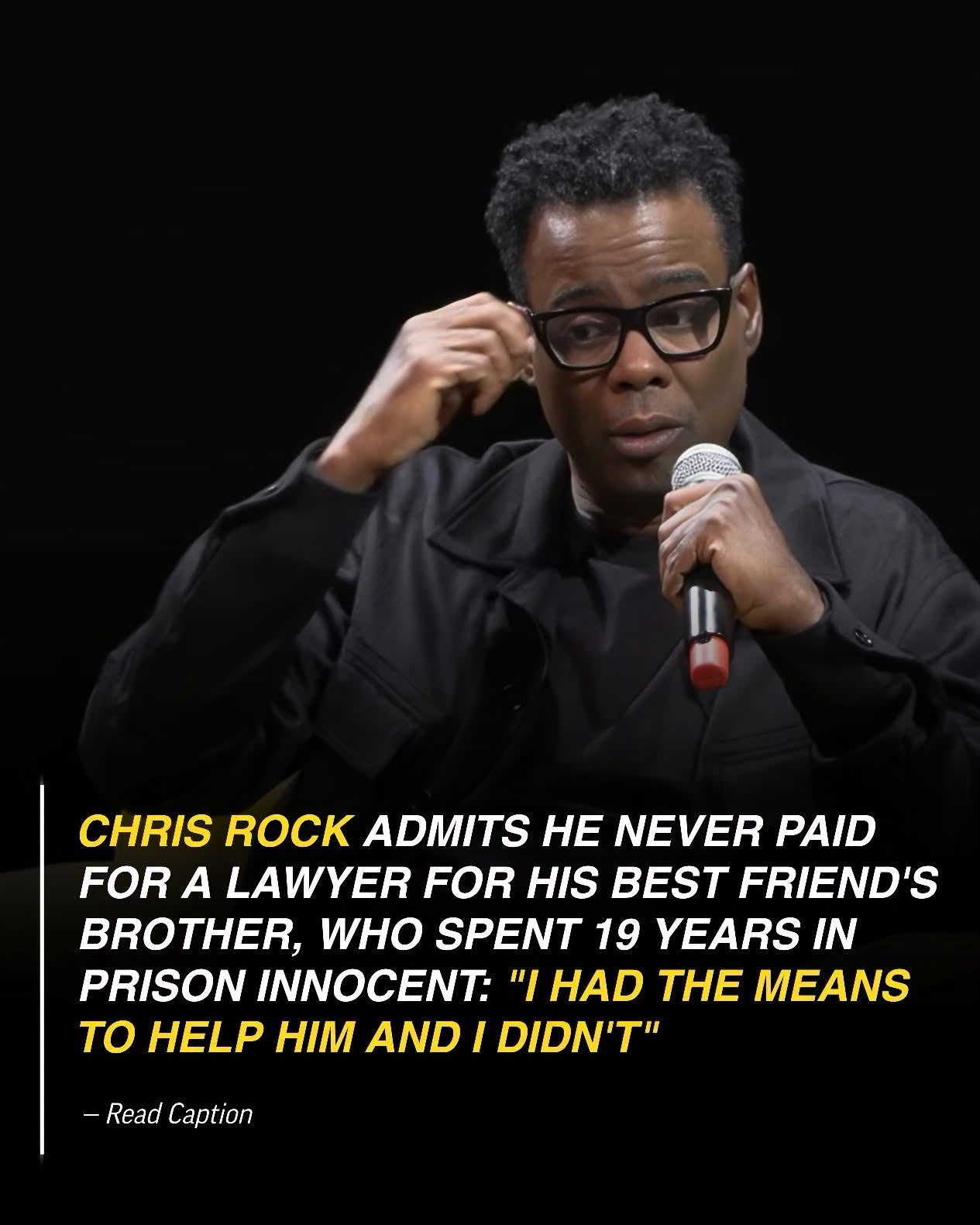
Chris Rock, Roger Logan, and the 19 Years That Could Never Be Given Back
For 19 years, Roger Logan lived with something no innocent person should ever have to endure: prison for a crime he did not commit.
Behind the walls of a prison, time moves differently. Years that might otherwise be filled with family celebrations, friendships, careers, ordinary conversations, and everyday moments disappear one day at a time. For Logan, 19 years were taken from him.
His story also carried a deeply personal connection to comedian Chris Rock.
Rock and Logan came from the same neighborhood. Logan’s brother was not simply an acquaintance of Rock’s; he was one of Rock’s best friends. Their connection went back years, to a time before fame, wealth, and celebrity changed the comedian’s life.
That connection eventually put Rock in an uncomfortable position.
For years, Logan’s brother asked Chris Rock to help pay for a lawyer who could assist his brother. Rock had become successful and had the financial means to contribute. Yet he did not.
That decision became one of the most complicated parts of the story—not because Rock believed Logan was guilty, but precisely because he says he did not.
Rock later acknowledged that he had the money to help. He also made clear that his decision was not based on an assumption that Logan deserved to be in prison. Instead, Rock explained that he had always kept his distance from lawyers and legal situations.
His reasoning was simple, but also revealing: once you get involved, you may not know where it starts or where it ends.
For Rock, the issue was not necessarily money. It was the fear of becoming entangled in a complicated legal situation whose boundaries he could not see.
Still, knowing that someone you know is imprisoned for a crime they did not commit—and knowing that you have the resources to help—creates an uncomfortable moral question.
What do you owe someone from your past?
And what happens when helping one person means stepping into a world you have deliberately avoided?
A friendship that existed before fame
Chris Rock’s connection to Logan was rooted in the neighborhood where they grew up.
Before Rock became a household name, before stand-up comedy brought him national attention, and before he became one of the most recognizable comedians in the world, he was simply a young man growing up around other young people.
Among those people was Roger Logan’s brother.
The two became close friends. Their friendship belonged to an earlier chapter of Rock’s life, when relationships were based less on status and more on shared experiences.
That history made Logan’s imprisonment especially difficult to separate from Rock’s own past.
Logan was not a complete stranger whose name happened to appear in a newspaper. His brother was someone Rock knew well.
For years, that friend reportedly appealed to Rock for financial help to secure legal representation for Logan.
The requests continued, but Rock did not provide the money.
From the outside, it might be easy to interpret such a decision in the harshest possible way. A wealthy celebrity was asked to help an apparently innocent man and chose not to. But Rock’s later explanation complicates that interpretation.
He did not say he refused because he believed Logan was guilty.
He did not say he lacked the money.
In fact, he admitted the opposite.
He could have helped financially.
He simply chose not to enter the legal situation.
The complicated line between money and involvement
One of the most interesting aspects of Rock’s explanation is that it goes beyond the question of whether he could afford to help.
By the time Logan’s case became an issue for him, Rock had achieved a level of financial success that made the cost of a lawyer less personally threatening than it might have been for an ordinary person.
Yet Rock saw the decision through a different lens.
Lawyers and legal cases, in his view, can create complicated obligations. What begins as a simple contribution can become something much larger.
You might pay for a lawyer.
Then there could be questions.
You might be asked to become involved.
You might be expected to provide information.
You might become connected to other people involved in the case.
The situation could expand beyond the original request.
Rock’s concern was essentially that there is no easy way to know where that involvement begins or where it ends.
That perspective does not necessarily make the decision easy to judge.
It does, however, show that Rock understood the distinction between having the ability to help and being willing to become part of a legal battle.
Those are not always the same thing.
The weight of 19 years
For Roger Logan, however, the consequences were enormous.
Nineteen years is an extraordinary amount of time.
It is long enough for children to become adults. It is long enough for friendships to change, neighborhoods to transform, and entire chapters of people’s lives to disappear.
Someone who enters prison at one stage of life can emerge into a world that feels almost unrecognizable.
Technology changes.
People move away.
Relationships evolve.
Family members age.
Friends build careers and families.
The person who comes home after nearly two decades is forced to reconnect with a life that continued without him.
For Logan, freedom eventually came.
But freedom after wrongful imprisonment is not simply the opposite of incarceration. There is a process of rebuilding. A person has to find a way to live with years that cannot be recovered.
No amount of money can return those birthdays, conversations, ordinary afternoons, or opportunities.
And no apology can literally give someone back the time that was taken from them.
That is what makes wrongful imprisonment so devastating.
The injustice is not limited to the prison sentence itself. The damage stretches into the years afterward.
The reunion
One of the most striking parts of the story is what happened when Rock and Logan eventually saw each other again.
After 19 years had passed, there was an obvious gulf between the two men.
One had spent nearly two decades behind bars.
The other had spent those years building a remarkable career and becoming an international celebrity.
Their lives had moved in dramatically different directions.
Yet when they reunited, something familiar remained.
They were able to talk and reconnect almost as though the years had not completely erased the friendship and familiarity that existed before Logan went to prison.
That moment carries a strange mixture of sadness and warmth.
On one hand, it demonstrates the resilience of human relationships. Nineteen years can change almost everything, but sometimes a connection formed in youth survives the passage of time.
On the other hand, it highlights just how much had been lost.
They could reconnect.
But they could not rewind the clock.
The fact that the conversation felt natural did not make the missing years disappear.
The uncomfortable question of responsibility
Rock’s story raises a question that goes beyond celebrity and money.
When someone you know is in serious trouble, how much responsibility do you have to help?
There is no universal answer.
People have different boundaries, different fears, and different understandings of responsibility. A person may have the financial ability to solve a problem without believing that they are personally obligated to do so.
At the same time, money can create opportunities to intervene in situations where other people have no options.
That tension is particularly powerful in Logan’s case.
Rock had resources.
Logan needed legal help.
Logan’s brother repeatedly asked for assistance.
And yet Rock stayed away.
The decision may be uncomfortable, but Rock’s willingness to admit that he could have helped makes the story more complicated than a simple tale of generosity or cruelty.
He did not hide behind the claim that he was broke.
He did not pretend that the money was impossible to find.
Instead, he acknowledged that he had the means and chose not to become involved.
There is a certain honesty in that admission, even if people may disagree with the choice.
Fame changes the meaning of an old friendship
The story also illustrates something that can happen when someone becomes famous.
Old relationships do not necessarily disappear when fame arrives. Instead, they can become more complicated.
A person who knew you before you were successful may suddenly see you as someone capable of doing things that ordinary people cannot.
If a friend needs $500, the request may be manageable.
If a friend needs substantial money for legal representation, the situation can become different.
The celebrity may be viewed not only as a friend but as a potential source of rescue.
That creates a difficult dynamic.
The person asking may feel that a friend with money should help.
The celebrity may feel that friendship does not automatically create financial or legal obligations.
Neither perspective completely eliminates the other.
In Rock’s case, the friendship with Logan’s brother meant that the request carried emotional weight. But Rock’s concerns about becoming involved in the legal system ultimately outweighed his willingness to participate.
The irony of the ending
Perhaps the most powerful irony is that after all those years, the relationship did not seem to require an elaborate explanation.
When Rock and Logan finally reunited, they were able to speak and reconnect.
The passage of time had not completely destroyed their connection.
That may be one of the most human parts of the entire story.
People often imagine that 19 years would make two people strangers. Sometimes it does. But shared history can remain remarkably durable.
A familiar voice, a memory, an old joke, or a simple conversation can bridge years that otherwise seem impossible to cross.
For Logan, however, the reunion could not erase what happened.
He had lost 19 years.
Rock could reconnect with him, talk to him, and remember the person he had known before prison.
But neither friendship nor success could restore the years that had been taken away.
More than a story about Chris Rock
It would be easy to frame the story entirely around Chris Rock.
He is, after all, the famous figure involved.
But at its center, the story belongs to Roger Logan.
The most important fact is not that a celebrity declined to pay for a lawyer.
It is that a man spent 19 years in prison for something he did not do.
Rock’s role adds a layer of moral complexity, particularly because he later acknowledged that he had the money to help.
But Logan’s experience is the reason the story matters.
Wrongful imprisonment forces society to confront the enormous consequences of mistakes within the justice system. A person can eventually walk out of prison, but the years spent inside cannot be returned.
And when that person emerges, the world has moved forward without them.
A complicated legacy
Chris Rock’s decision remains open to interpretation.
Some people may see it as a failure to help a friend’s family when he had the means.
Others may understand his reluctance to become involved in a legal case, particularly when he feared that writing a check could lead to obligations he did not anticipate.
Rock himself did not present the decision as a financial impossibility.
He presented it as a boundary.
That distinction matters.
At the same time, boundaries can have consequences.
For Logan, the consequence was that his brother’s repeated appeals for assistance did not result in Rock’s financial involvement.
Eventually, Logan was freed.
And when he and Rock met again, the years between them did not completely destroy their ability to connect.
Their reunion serves as both a testament to friendship and a reminder of lost time.
Nineteen years is a lifetime within a lifetime.
It is long enough to change a person, a family, and a community.
The fact that two people can meet again after such a separation and still find something familiar in each other is remarkable.
But perhaps the most haunting part of the story is that their conversation could feel almost as though no time had passed—when, in reality, 19 years had passed.
For Roger Logan, those years were real.
They were lived behind prison walls.
They were years he could never recover.
And that is what ultimately gives the story its emotional weight: not the celebrity involved, not the money that could have been spent, and not even the reunion itself, but the simple truth that time lost to wrongful imprisonment can never be completely given back.