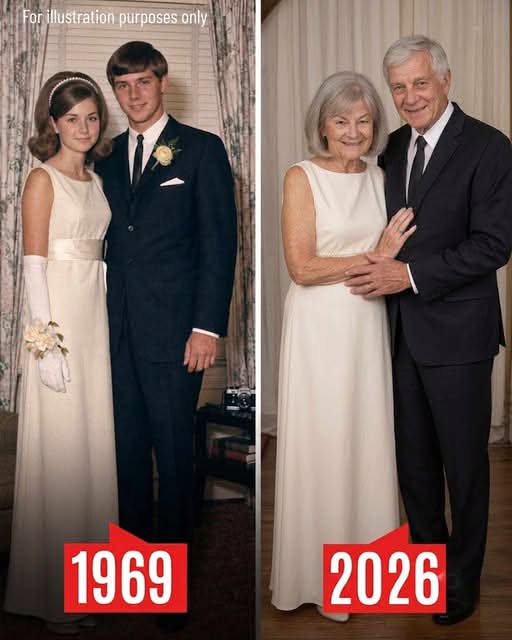
I kept my prom dress hidden in the attic for 55 years because I had once promised my high school sweetheart I would marry him in it before he was sent to Vietnam. Then one evening, he appeared at my door, revealed a secret that made me question the woman I had trusted all my life.
The oldest thing in my house was an ivory dress hanging inside a faded garment bag in the attic.
The dress wasn’t expensive.
Even in 1969, it had been simple. A narrow waist, short lace sleeves, and a skirt that reached just below my knees.
But I had guarded it more carefully than anything else I owned.
Every spring, I climbed into the attic, opened the bag, checked the fabric, and let it breathe beside the little window for an afternoon.
Then I folded it back into its place.
My older sister, Corinne, always thought it was ridiculous.
“You’re going to turn seventy-four this year, Lenora,” she told me during one of our Sunday phone calls. “That dress belongs in a museum.”
“It belongs where I put it.”
“You’ve always been stubborn.”
Maybe I was.
But that dress carried the last promise I had made to the boy I loved before the war took him away.
His name was Everett Shaw.
We met when we were fifteen.
There was nothing dramatic about it.
He sat behind me in history class and spent three weeks borrowing pencils before I realized he always had two in his shirt pocket.
“You just wanted an excuse to talk to me,” I accused him one afternoon.
Everett smiled.
“It took you long enough.”
We were together from then on.
By senior year, everybody assumed we’d marry.
So did we.
At prom, Everett kept stepping on my shoes because he was a terrible dancer, but I didn’t care.
I remember leaning against his shoulder while a slow song played and thinking that whatever happened in life, I would be fine as long as I had him.
Two weeks after graduation, Everett was drafted.
That changed everything.
The night before he left, we drove up to a hill outside town where we used to park when we wanted to be alone.
We stayed there until the sky began to turn pale.
We talked about everything waiting for us after he came home.
A small house.
Maybe two children.
A dog Everett wanted and I absolutely did not.
He said he’d find work at his uncle’s hardware store until we could save enough money to open something of our own.
I had brought my prom dress in the back seat because my mother had recently picked it up from the cleaners.
Everett saw the garment bag and smiled.
“Is that the dress?”
“What dress?”
“The one I’m going to marry you in.”
I laughed.
“You don’t get to choose my wedding dress.”
He reached over and touched my hand.
“Then promise me something.”
There was something different in his face.
Suddenly, neither of us was laughing.
“What?”
“Save it.”
“For what?”
“For me.”
He looked toward the horizon.
“When I come home, we’ll get married. You can wear that.”
I knew he was trying to make the goodbye easier.
So I smiled.
“I’ll save it.”
“Promise?”
“I promise.”
Everett kissed me just before sunrise.
The next morning, he left.
For months, letters arrived whenever they could.
Some were long.
Some were only a few lines.
He complained about the heat.
He asked about my parents.
He reminded me not to let his younger brother touch the old motorcycle he’d left behind.
In almost every letter, he ended with some version of the same sentence.
Don’t forget about me.
I never did.
Then the letters stopped.
At first, everyone told me not to panic.
Mail was unreliable.
Men were moved around.
Sometimes weeks passed without news.
Then Everett’s parents received the notice.
He had been declared missing in action.
No body.
No grave.
No goodbye.
Just missing.
I hated that word.
Dead was terrible, but it was an answer.
Missing left the door open.
For years, I kept expecting Everett to walk through it.
At twenty-five, people told me to move on.
At thirty, they told me I had wasted enough time.
At forty, people stopped asking why I had never married.
By fifty, most of the people who remembered Everett as a young man were gone.
His father died first.
His mother followed several years later.
My parents died too.
Friends became grandparents.
Children I once babysat brought their own children to see me.
And still, every spring, I climbed into the attic.
Corinne was the only person who regularly argued with me about it.
“You can’t spend your entire life keeping a promise to someone who may not even be alive,” she said once.
“I already have.”
She stared at me.
“That isn’t romantic, Lenora. It’s sad.”
Maybe it was.
But I had built a life.
I worked at the town library for thirty-seven years.
I traveled.
I had friends.
I volunteered at church.
I wasn’t sitting beside the window every day waiting for Everett to come home.
But some part of me had never closed that chapter.
I simply learned how to live with it unfinished.
Then, fifty-five years after Everett disappeared, somebody knocked on my door.
It was early evening.
I remember because I had just made tea.
I wasn’t expecting anyone, so I almost ignored it.
Then came a second knock.
Slow.
Almost hesitant.
I opened the door.
An elderly man stood on my porch.
His shoulders were thinner than I remembered.
His hair was completely silver.
His face carried lines I had never seen.
But I knew his eyes.
I would have known those eyes anywhere.
My hand slipped from the doorknob.
“Everett?”
His mouth trembled.
“Hello, Lenora.”
For several seconds, neither of us moved.
I thought my mind had finally betrayed me.
I reached out and touched his sleeve.
He covered my hand with his.
“I’ve been trying to get back to you for a very long time,” he whispered.
I began crying before I could stop myself.
“You’re alive.”
“I am.”
“They told us you were missing.”
“I know.”
I pulled him inside.
We sat in my living room until nearly sunrise.
Everett told me he had survived… (I know you’re all very curious about the next part, so if you want to read more, please leave a “YES” comment below