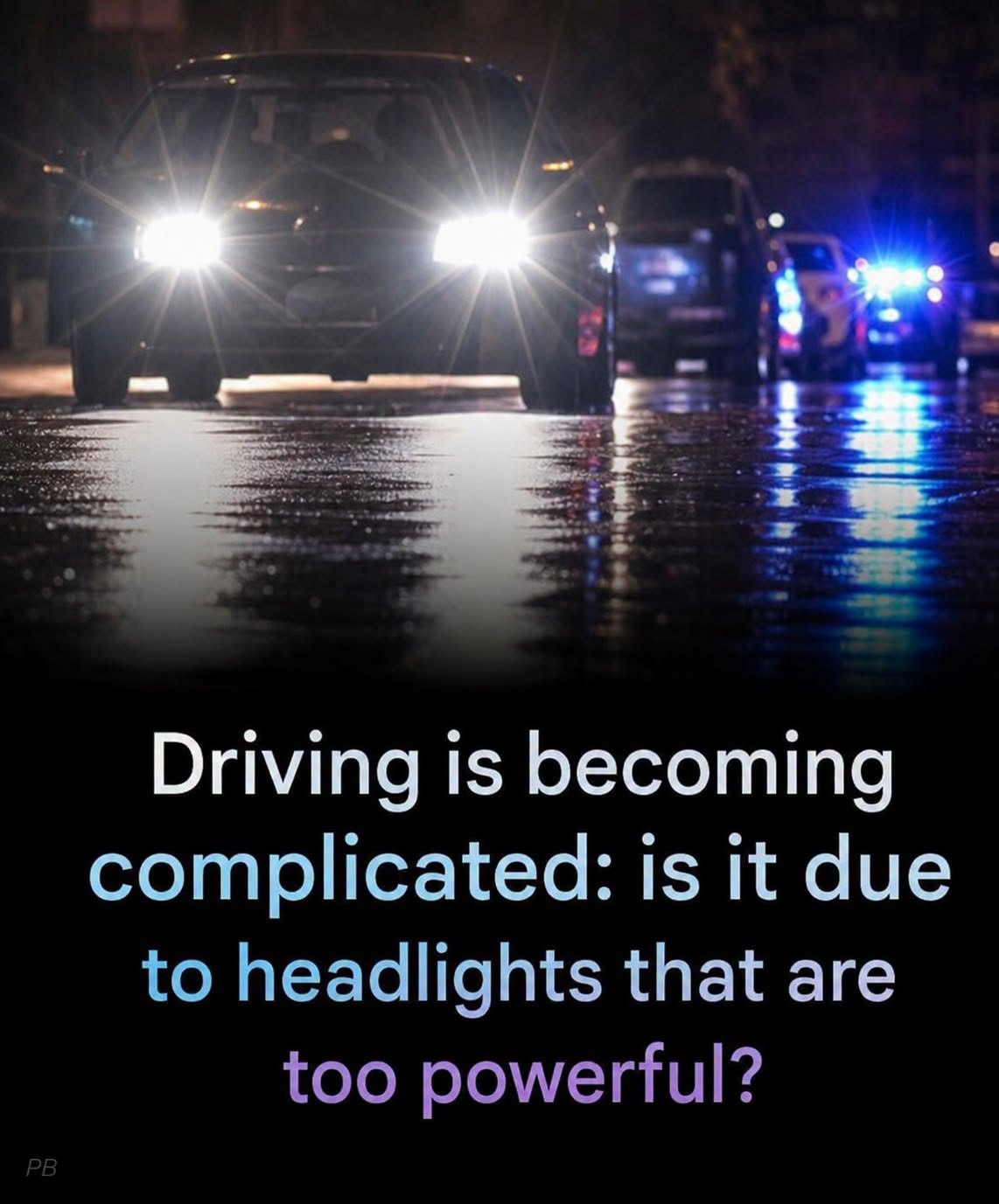
Headlights Too Intense? Why Are More and More Motorists Struggling to See the Road?
For many motorists, driving at night has become an increasingly uncomfortable experience. Roads that once seemed relatively easy to navigate after dark can now feel dramatically different, particularly when approaching vehicles are fitted with extremely bright headlights.
A driver may be traveling along a familiar road when suddenly a pair of intense white lights appears ahead. For several seconds, the road markings, pedestrians, cyclists, and even the edges of the carriageway can become difficult to see. Some drivers describe the sensation as being temporarily “blinded” by oncoming traffic.
The issue has become a growing source of concern among motorists, particularly as modern vehicles increasingly use powerful LED and high-intensity lighting systems. While these technologies can provide significant benefits, including improved visibility for the driver using them, they can also create problems for other road users when the lighting is poorly adjusted, incorrectly used, or simply too intense for surrounding conditions.
So, are headlights genuinely getting brighter? Why do some modern headlights feel so dazzling? And what can motorists do to protect their vision and stay safe when driving at night?
Why Modern Headlights Can Feel So Bright
Vehicle lighting has changed substantially over the past few decades.
Older vehicles commonly relied on halogen bulbs, which typically produced a warmer, yellowish light. Modern cars increasingly use LED headlights, which can produce a much whiter and more intense beam while consuming relatively little energy.
LED technology itself is not necessarily dangerous. In fact, properly designed and correctly aligned LED headlights can provide excellent illumination of the road ahead. The problem arises when the light is directed into the eyes of another driver or when its intensity and color create excessive glare.
Modern headlights can also be designed to produce a very sharply defined beam. Advanced lighting systems may automatically adjust illumination depending on traffic and road conditions. When these systems work correctly, they can improve visibility considerably.
However, when a vehicle is heavily loaded, traveling over uneven roads, incorrectly aligned, modified with unsuitable bulbs, or equipped with an aftermarket lighting system that does not meet appropriate standards, the beam can end up pointing directly toward approaching motorists.
That can turn a useful safety feature into a serious distraction.
LED Headlights and the “Blue-White” Effect
One reason modern headlights can feel particularly harsh is their color.
Many newer headlights produce a cooler, blue-white light rather than the warmer tone associated with traditional halogen bulbs. This difference can make the light appear more intense, even when its measured brightness is not dramatically different.
Shorter-wavelength blue light can also contribute to the perception of glare. Human eyes are not equally sensitive to every wavelength, and certain lighting conditions can make it harder for the visual system to recover quickly after exposure to a bright source.
This is particularly noticeable at night, when the surrounding environment is dark.
Imagine sitting in a dark room and suddenly having a bright flashlight pointed directly at your eyes. Even after the flashlight disappears, it can take a moment for your vision to return to normal.
A similar process happens when a driver encounters a powerful headlight on a dark road.
During that brief period, the driver’s ability to see objects outside the bright beam may be reduced.
Why Glare Is More Dangerous at Night
Night driving already places greater demands on the human visual system.
In darkness, the pupils become larger to allow more light into the eyes. Drivers depend heavily on the limited illumination provided by streetlights, vehicle headlights, reflective road signs and other sources.
When an extremely bright light suddenly enters the field of vision, the contrast between the light source and the surrounding darkness can be enormous.
The result can be temporary visual discomfort and reduced visibility.
A driver may still be able to see the headlights themselves clearly, but the road around them can effectively disappear for a moment. This phenomenon is especially concerning on roads without adequate street lighting.
A pedestrian wearing dark clothing, a cyclist without strong illumination, an animal crossing the road or an unexpected obstacle may become harder to identify while the driver is recovering from glare.
Even a few seconds can matter when a vehicle is traveling at speed.
The Problem With High Beams
High-beam headlights are designed to illuminate a much longer stretch of road than standard low beams.
They can be extremely useful on dark rural roads where there is little or no street lighting. However, high beams can become dangerous when used around other motorists.
When a driver approaches an oncoming vehicle, the high beam should normally be dipped so that the other driver is not exposed to an intense beam directly into their eyes.
Unfortunately, not every driver follows this practice consistently.
Some motorists may forget to switch from high beam to low beam. Others may deliberately continue using high beams because they believe they can see better.
The problem is that improving one driver’s visibility at the expense of another driver’s vision does not make the road safer.
It can have the opposite effect.
Automatic High Beams Can Also Create Problems
Modern vehicles increasingly come with automatic high-beam systems.
These systems use cameras or sensors to detect other vehicles and automatically switch between high and low beams. In many situations, they work remarkably well.
However, no automated system is perfect.
Curved roads, hills, weather conditions, reflective surfaces and unusual traffic situations can sometimes make it more difficult for a vehicle’s sensors to identify another road user correctly.
A driver should therefore remain responsible for monitoring the lighting system rather than assuming the vehicle will always make the correct decision.
Automatic systems can be helpful, but they should not replace good judgment.
Headlight Alignment Matters
Brightness is only part of the issue.
The direction in which a headlight points can be just as important.
Headlights are carefully designed to illuminate the road ahead without unnecessarily shining into the eyes of other drivers. If they are incorrectly aligned, the beam may be aimed too high.
This can happen for several reasons.
A vehicle may have been involved in an accident. Suspension components may have changed. The car could be carrying a heavy load in the rear. Headlight assemblies may have been replaced incorrectly.
Even a small change in the angle of a headlight can significantly affect where the beam lands.
Drivers who frequently receive complaints about their headlights should have them professionally checked rather than simply assuming that brighter bulbs are the solution.
Larger and Heavier Vehicles Can Make Glare Worse
Another factor is the increasing popularity of SUVs, pickup trucks and other larger vehicles.
Because these vehicles often sit higher than conventional passenger cars, their headlights can be positioned at a greater height.
For the driver of a lower vehicle, that can mean the headlights are closer to eye level.
This does not automatically make larger vehicles unsafe, but the difference in height can influence how glare is experienced.
The same issue can occur when a vehicle is following another car closely. A driver may suddenly find themselves facing bright lights in their mirrors, making it harder to see clearly.
Age Can Affect Night Vision
Not every problem with nighttime visibility is caused by modern headlights.
Our eyes naturally change as we age, and many older drivers experience increased difficulty seeing at night.
The lens of the eye can become less transparent over time, while the ability to adapt quickly between bright and dark environments can decline.
Some people also become more sensitive to glare.
Conditions such as cataracts and other vision problems can further affect night driving, although only a qualified eye-care professional can determine whether an individual has an underlying eye condition.
This is why regular eye examinations can be particularly important for anyone who notices a significant change in their ability to drive after dark.
Dirty Windscreens Can Increase Glare
There is another surprisingly simple factor: the windscreen.
A windscreen that appears clean during the day may still contain tiny scratches, smears, dust particles or oily residue that scatter light at night.
When bright headlights shine through the glass, these imperfections can produce halos, streaks or a hazy appearance.
The problem can be even more noticeable when the windscreen is wet.
Regularly cleaning both the inside and outside of the windscreen can therefore make a meaningful difference to nighttime visibility.
Drivers should also make sure their windscreen wipers are in good condition. Worn blades can leave a thin film of water or dirt that dramatically increases glare.
Rain Makes Headlight Glare Worse
Driving at night in wet weather can be particularly challenging.
Rainwater reflects and scatters light, while wet roads can act like mirrors. Headlights from approaching vehicles may therefore appear to spread across the road surface.
This can make lane markings and other important visual information more difficult to distinguish.
The combination of darkness, rain, reflections and intense headlights can create a challenging environment even for experienced drivers.
Reducing speed in these conditions is often more effective than trying to compensate by staring directly at the bright light.
What Should Drivers Do When They Are Dazzled?
One common mistake is staring directly at the approaching headlights.
Human attention is naturally drawn toward bright objects, but looking directly at an intense light can make glare feel even more overwhelming.
Instead, drivers can focus on the left-hand side of their lane or toward the road edge, depending on the road layout and local driving rules, while maintaining awareness of surrounding traffic.
They should also avoid sudden steering movements.
If visibility becomes severely compromised, reducing speed appropriately can give the driver more time to respond to hazards.
The key is to remain calm and maintain control rather than reacting aggressively to the other vehicle.
Should Drivers Use Tinted Glasses?
Some motorists consider using specially tinted or yellow-tinted glasses for nighttime driving.
However, drivers should be cautious.
Any eyewear that reduces the amount of light reaching the eyes can potentially make it harder to see in already-dark conditions. Sunglasses should never be used for ordinary nighttime driving.
If a person experiences persistent difficulty with glare, the best approach is to have their eyesight assessed and discuss the problem with an eye-care professional.
The goal should be to improve vision rather than simply make the environment darker.
What Can Vehicle Owners Do?
There are several practical steps motorists can take.
First, check that the headlights are correctly aligned.
Second, replace damaged or cloudy headlight covers if necessary.
Third, use the correct bulbs and components recommended for the vehicle. Installing extremely bright aftermarket bulbs without considering the design of the headlight housing can create an improperly focused beam.
Fourth, use high beams responsibly and dip them when approaching other road users.
Finally, keep the windscreen, mirrors and headlights clean.
These measures may sound basic, but they can significantly improve nighttime visibility.
Are Regulations Keeping Up With Modern Lighting?
The growing popularity of high-output LED lighting has prompted broader discussions about vehicle lighting standards and glare.
The challenge for regulators is finding the right balance.
Headlights need to be powerful enough to illuminate modern roads effectively, but they also need to prevent excessive glare for other road users.
As lighting technology becomes more sophisticated, regulations and testing procedures must evolve alongside it.
The issue is not simply whether a headlight is “bright.” Engineers and regulators also have to consider beam pattern, light distribution, color, vehicle height, automatic adjustment and how the system performs under real-world conditions.
Why This Is a Road-Safety Issue
Headlight glare may seem like a minor inconvenience, but it can have serious consequences.
Driving requires constant visual processing. Motorists need to identify road signs, lane markings, pedestrians, cyclists, animals, traffic signals and other vehicles.
If glare temporarily reduces the ability to process that information, reaction times can effectively become more critical.
The problem is particularly significant on high-speed roads, where a vehicle can travel a considerable distance in just a few seconds.
A momentary loss of visibility may therefore be enough to create a dangerous situation.
The Future of Headlights
The future of vehicle lighting is likely to involve even more advanced technology.
Adaptive headlights can selectively illuminate portions of the road while reducing light directed toward other vehicles. Matrix LED systems can use multiple individually controlled lighting elements to create more sophisticated beams.
These technologies have the potential to improve nighttime driving considerably.
But technology alone cannot eliminate glare.
Correct calibration, maintenance, regulation and responsible driving behavior will remain essential.
A Shared Responsibility
The debate about bright headlights can sometimes become a battle between drivers of different types of vehicles or between older and newer cars.
But the underlying issue is more straightforward.
Every road user needs to be able to see and be seen.
A driver with powerful headlights has a responsibility to ensure they are correctly adjusted and used appropriately. A driver experiencing persistent difficulty with nighttime vision has a responsibility to have their eyesight checked. Vehicle manufacturers have a responsibility to design lighting systems that balance illumination with glare control. Regulators have a responsibility to ensure that standards reflect modern technology.
Ultimately, safer nighttime driving depends on all of these factors working together.
Conclusion
The experience of being temporarily blinded by an approaching vehicle is becoming increasingly familiar to many motorists. Modern LED headlights, larger vehicles, automatic lighting systems and brighter aftermarket products have changed the nighttime driving environment.
However, the issue cannot be reduced to one simple explanation.
Headlight glare is influenced by brightness, beam direction, color, vehicle height, road conditions, weather, windscreen cleanliness and the driver’s own vision.
For motorists, the most important steps are straightforward: keep headlights correctly aligned, use high beams responsibly, maintain clean windscreens and lighting equipment, reduce speed when visibility is poor and seek professional eye care if nighttime vision has deteriorated.
Modern headlights can make roads safer by helping drivers see further and identify hazards sooner. The challenge is ensuring that better illumination for one driver does not become dangerous glare for another.
As vehicles continue to become more technologically advanced, the goal should not simply be brighter headlights. It should be smarter, better-controlled lighting that helps everyone see the road safely.